
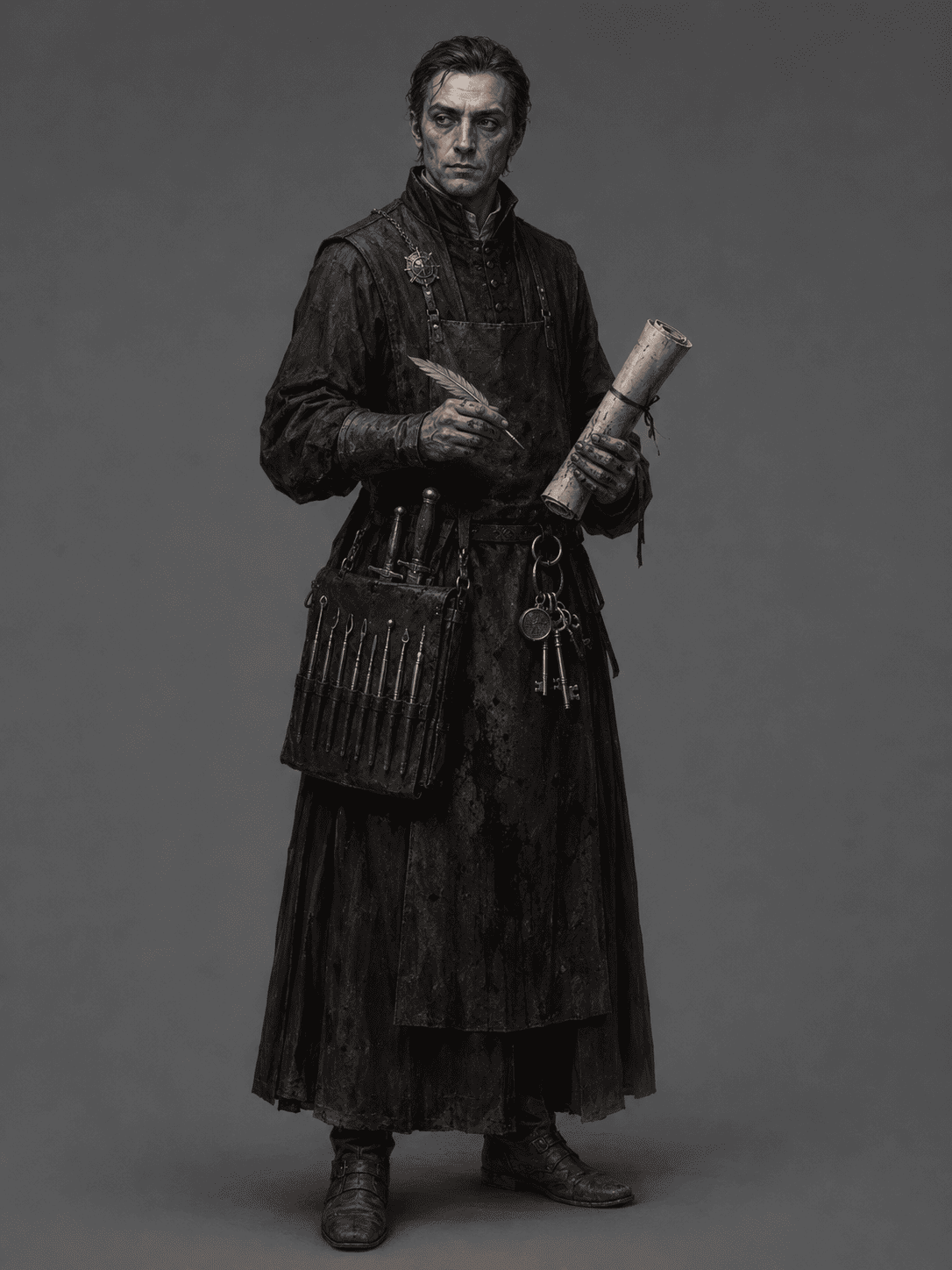
Ion Greyquill
Protagonist

Ion Greyquill

Throne Coroner · House Greyquill

Throne coroner of the Iron Capital dynasty, in his 17th year holding the seal. He believes not in fate, only in corpses and records—until he reads, on the old king's body, a word that should not exist.

Faction
王座驗屍官
Related characters
0 people
Faction members
0
Related entries
0 entries

Character profile

Background / motivation / observation stance

Ion Greyquill

Throne Coroner of the Iron Capital Dynasty, thirty-eight years old, in his 17th year holding the seal, born of the Greyquill family who have presided over royal-tomb rites for generations. He has spent 17 years in the auxiliary vault beneath the royal mausoleum, keeping company with corpses, ancient scrolls, and records.

He does not believe in gods, nor in the mandate of heaven—only in what he sees beneath the blade and records on paper. 'Greyquill' is the origin of the family name—a goose-feather pen that can write on the skin of a corpse, its strokes never fading.

The Old King's Tongue

The 105th king passed away, his corpse left for 4 days, and Ion presided over the examination. From the inner side of the king's breastbone he pried out a black, curved piece of something hard—like a tooth, yet like a crown-horn—half of it protruding through the flesh, giving off the faintest silver glow.

He lifted the king's tongue, and on its surface was a single character—not written, not carved, but grown out of the flesh. He recognized it: the 'Void' of the Era of Gods, drawn from a funerary text no one had opened in three hundred years. He reached a conclusion no one dared to reach: the king did not die of poison—he died of being called a name.

The Hidden Shard

In the autopsy room stood the High Pontiff, the Princess, and the Captain of the Royal Guard—several pairs of eyes among them wishing this report to read 'poisoning.' He noticed one thing: when the Pontiff saw that glyph, he did not draw a sharp breath—as though he had seen it long before.

When the autopsy was done, he wrapped that fragment of black shard in silver paper and hid it in the secret compartment of his tool bag.

The Empty Statues

Along the royal-tomb gallery stood the bronze statues of ritual officials across the ages, meant to be three rows for the three great houses. He had walked that gallery for 17 years, at least 800 times, and only now noticed for the first time: the 12 places in the third row were all empty—the statues gone, the names erased from the records as well.

On that empty stone base, a single glyph was carved. He had seen it elsewhere.

His Father's Words

His father and his grandfather both died of the same inexplicable 'heart-stop.' On his last night before death, his father urged him only this: this work will consume your whole life—if you can avoid it, then don't do it.

Years later, at the bottom of a sandalwood box his father had left behind, he found a newly surfaced line on the back of a manuscript page—it was his father's handwriting, yet his father had been dead for 12 years. That line read: The third house is you.

The Hidden Door Beneath the Gallery

A letter of unknown origin, its wax seal stamped with 'a circle, a triangle, a dot,' led him to the seventh empty niche of the third house's statues in the royal-tomb gallery. Beneath the stone base was a hidden door.

Within the hidden door was concealed a small silver seal, its base carved with that recurring glyph. When the seal pressed against his palm, it vibrated gently 3 times—and afterward, a silver mark was left on the palm of his right hand.

The Lower Vault

The lower vault beneath the royal tombs holds its temperature year-round on the thickness of the stone alone. There are no windows; the light is a row of oil lamps along the wall, refilled every third day.

He has been down here 17 years. The furnishing has scarcely changed: a stone table at the centre, scroll racks on all four walls, tools on the door side, and at the far end the cold chamber where bodies wait.

He writes his records on a low stool beside the table. The stool is uncomfortable and his back aches after a long sitting, but a man who sits comfortably writes slackly. His father said so.

Few people come down from above. He has never once thought that a pity.

Greyquill

The family name comes from a quill—a grey ink ground from particular minerals, which will write on the skin of a corpse without bleeding, and washes off afterwards leaving nothing.

During an examination he uses it to mark the body: where the cut begins, which place wants a second look, which finding does not match the record. The marks are for himself, and they are washed clean before he finishes.

The recipe passes only to whoever holds the seal. He took it from his father at 21, copied it out once, and burned the original.

In 17 years the bodies he has examined and recorded number 1,142. Every record is still on the racks, ordered by year, and he can find the shelf for any year with his eyes shut.

0 observers liked this

Observer comments

Discussion about this character

Observer comments

0 records

No comments yet. Be the first observer.

Latest chapters