
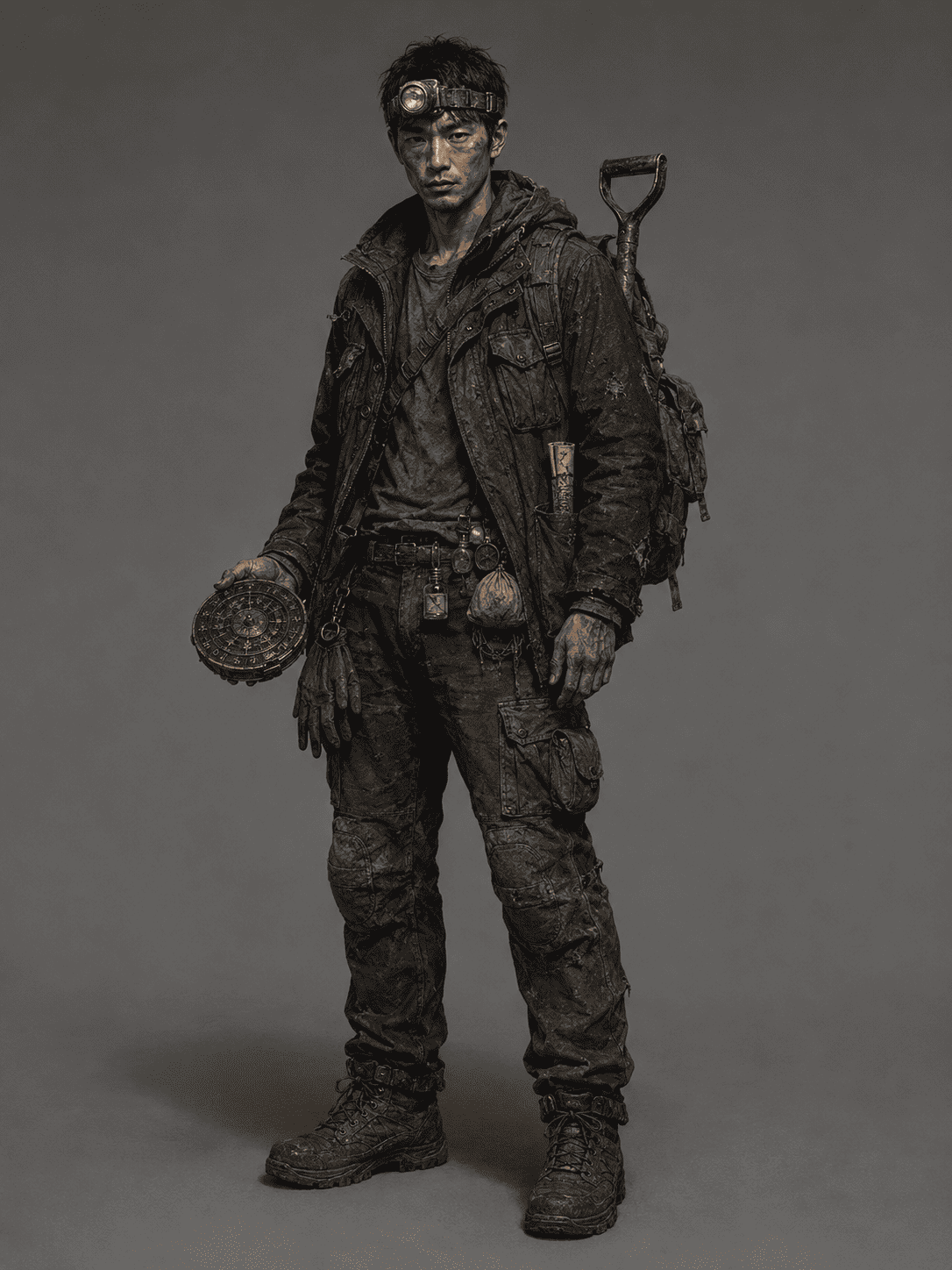
Shen Zhaoye
Protagonist

Shen Zhaoye

Heir of a Fenjin Lineage

Heir of a fallen fenjin tomb-seeking lineage. He trusts only terrain, airflows, rock strata, magnetic declination, and the engineering logic of tombs—not gods. Until, to clear a debt, he takes a job he shouldn't and walks into a nameless imperial tomb.

Faction
分金世家
Related characters
0 people
Faction members
0
Related entries
0 entries

Character profile

Background / motivation / observation stance

Shen Zhaoye

The descendant of a fallen Fenjin family, Fenjin Point-Siting is his inherited craft. He doesn't believe in gods, doesn't believe in fate—he believes only in terrain, qi-mouths, rock strata, magnetic declination, the firing-date of tomb bricks—a set of things that can be verified, that can be measured with a compass.

He has an heirloom Hanlong Fragment in hand, though the latter half was torn away long ago. He is calm and cautious, unshaken by the dead he's seen in tombs; yet the greatest trouble of his life is discovering that some things simply cannot be measured by the logic of Fenjin.

The Three Kinds of Spots

Before his death, his grandfather warned him of three kinds of spots. He didn't fully understand it all; he only remembers the look on the old man's face as he spoke—not like passing down the family craft, but like passing on something he should never touch in his entire life.

After his grandfather passed, in order to repay a debt, he took on a job arranged anonymously through a mailbox and a Swiss bank: to divine the spot of a nameless imperial tomb. What he didn't know then was that, before he took this job, others had already taken it—and then, one by one, lost all contact.

Into the Mountains

He entered the mountains along the outskirts of Guanzhong, guided by a local who had guarded these mountains for three generations. The mountains had more rules than the tombs did.

The deeper he went, the more he felt something was off about where this tomb had been sited—it was built in a place where, by the logic of Fenjin, no imperial tomb should ever stand. As if someone had deliberately chosen a wrong location to hide it away.

Seventy Degrees

Once inside the tomb passage, for the first time he measured a number that ran a chill down his spine. The slope, height, and width of the corridor—the proportions were all wrong. This passage didn't seem made for a person to walk through.

It seemed more like a path left for something larger than a person—and something that moved by crawling. He kept this judgment to himself, never speaking it aloud.

The Face of a Burial Figure

Further down were rows of burial figures, crafted by an ancient method he had never seen. But when his headlamp swept across the face of one of them, he froze.

The figure's eyes—the pupils were vertical. Not a slip of the craftsman's hand, but carved after something. Fenjin can measure the structure of a tomb; it cannot measure this.

What Cannot Be Measured

The deeper into the tomb he went, the more anomalies appeared—figures that didn't count right, a thing inscribed with sixteen characters, a husk that should not have been there. He began to understand that what this tomb buried might not be a dead emperor.

The third kind of spot his grandfather had warned of, and everything he now saw before him, were pushing down—inch by inch—the worldview he had held for twenty-eight years: that Fenjin was nothing but geology.

What He Carries

The compass came down through the family, brass-faced, the needle replaced once. Beyond it his pack holds a set of things that sit oddly in this trade: a geologist's hammer, a handheld magnetometer, a few sample tubes, a small notebook of magnetic declinations.

Others in the business joke that he has turned point-siting into a site survey. He does not answer. For him Fenjin Point-Siting is a craft that argues with numbers—the colour of a soil layer, the density of rammed earth, the firing temperature of a brick, the run of a ridge. Every one of them can be measured, and measurement allows inference.

He carries the inherited Hanlong fragment and rarely opens it. The second half was torn out long ago; the half that remains he has known by heart for years.

The one thing that does not run on numbers is his hands. A pinch of soil tells him the depth. That part cannot be taught.

His Grandfather's Three Lines

The family craft came from his grandfather. From the age of seven: soil first, then the shape of mountains, and the compass last of all. The teaching was hard—an error drew no scolding, only an order to walk that stretch of ground again, and again, until he got it right.

His grandfather had a few lines he repeated over the years: do not go down a shaft you do not know, do not break ground until you are certain, and when you cannot be sure, withdraw. He found them tedious at the time. Later, in several situations he barely came back from, those three lines were what he had.

What the old man said at the end he did not fully follow. He remembers the look on his face clearly. It was not the look of a man passing on a family craft.

After his grandfather died there was little left. The debt dates from then, and so does the reason he took that job.

0 observers liked this

Observer comments

Discussion about this character

Observer comments

0 records

No comments yet. Be the first observer.

Latest chapters